

You know the drawer. One fat laptop brick, one phone charger, one tablet plug, and a knot of cables that never coils the same way twice. The whole point of the best GaN charger 2026 has to offer is deleting that drawer: a single cube, sometimes the size of a matchbox, that runs your 65W laptop, tops up your phone, and still has watts to spare for a watch or earbuds. Pick the right one and you buy it once, then travel lighter for years.
This guide does two things most roundups skip. First, it shows you how to read wattage across ports so you are not fooled by a big number on the box. Second, it gives real picks by use case, with specs we dug into against manufacturer pages, not vibes.
The quick answer
For most travelers, the Anker Prime 100W is the cube to buy: it runs a laptop and phone together and folds flat for a bag. Want to spend less? The UGREEN Nexode 65W covers a phone plus a thin laptop. Packing phone-first? The Anker 511 Nano 3 is the true matchbox. There is a catch in how these chargers share power once you plug in a second device, and that catch decides which one is right for you. Jump to any pick below, or see the full comparison.
Some links in this article are affiliate links. If you buy through them, we may earn a small commission at no extra cost to you. Learn more.
As an Amazon Associate I earn from qualifying purchases.
On this page
- What GaN actually changes
- How to read wattage across ports
- The best GaN chargers for 2026, by use case
- How the 2026 GaN charger picks compare
- Which one belongs in your bag
What GaN actually changes
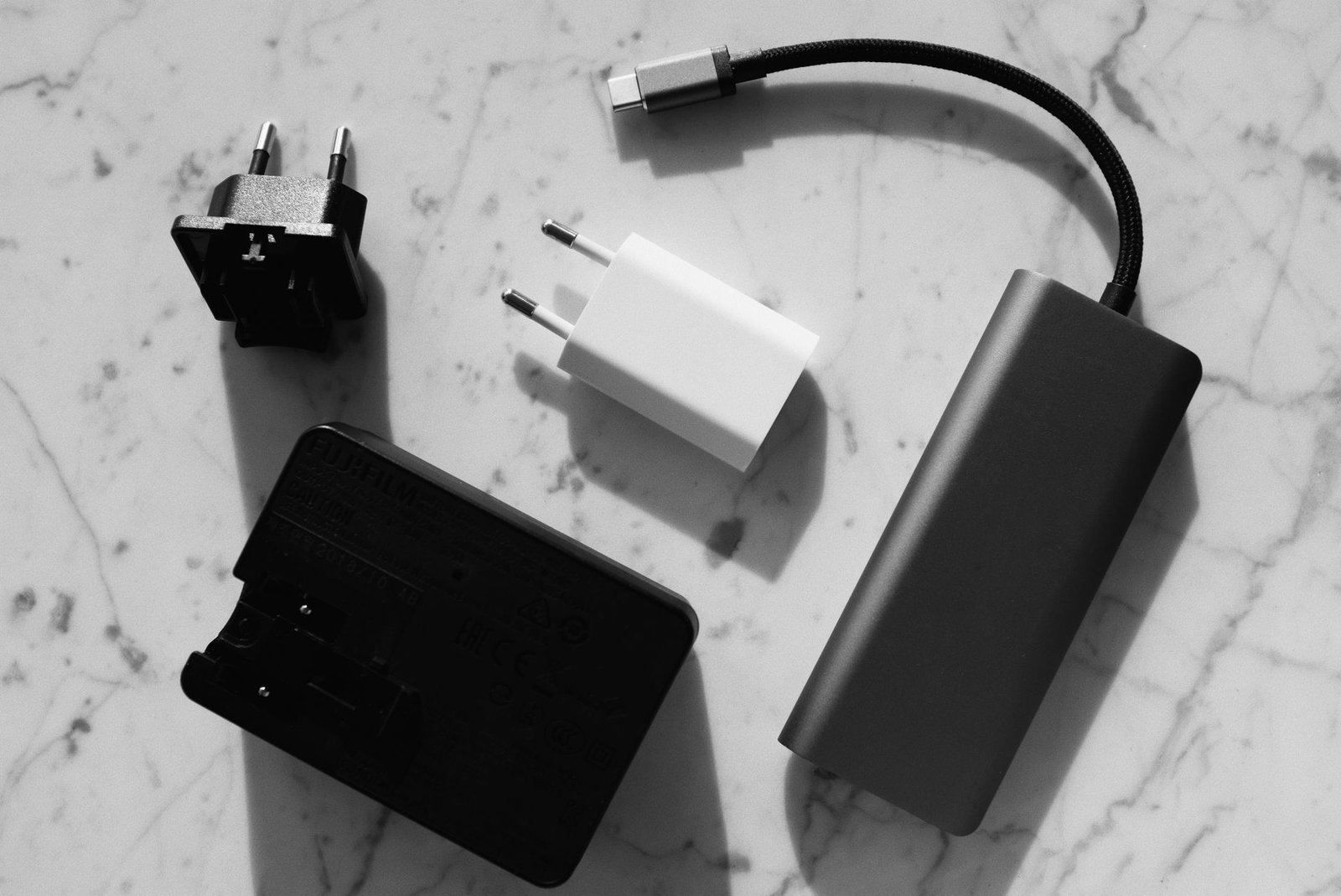
GaN is short for gallium nitride, the semiconductor that replaced silicon inside the charging brick. The material conducts electricity more efficiently and switches far faster: silicon power chips top out around a few hundred kilohertz, while GaN parts run at several megahertz. Because the internal magnetics shrink as switching frequency climbs, the whole charger shrinks with them. That is why a modern GaN unit runs roughly 30 to 50 percent smaller than the old silicon equivalent at the same wattage.
Less waste heat is the other half of the story. GaN loses less energy as heat at the same load, so more wall power actually reaches your device and the cube stays cooler in your hand. Cooler and smaller is not marketing fluff here; it is the direct reason one pocket cube can now do the job of three bricks. If you want the deep version, Anker’s own explainer on gallium nitride walks through the physics.
How to read wattage across ports
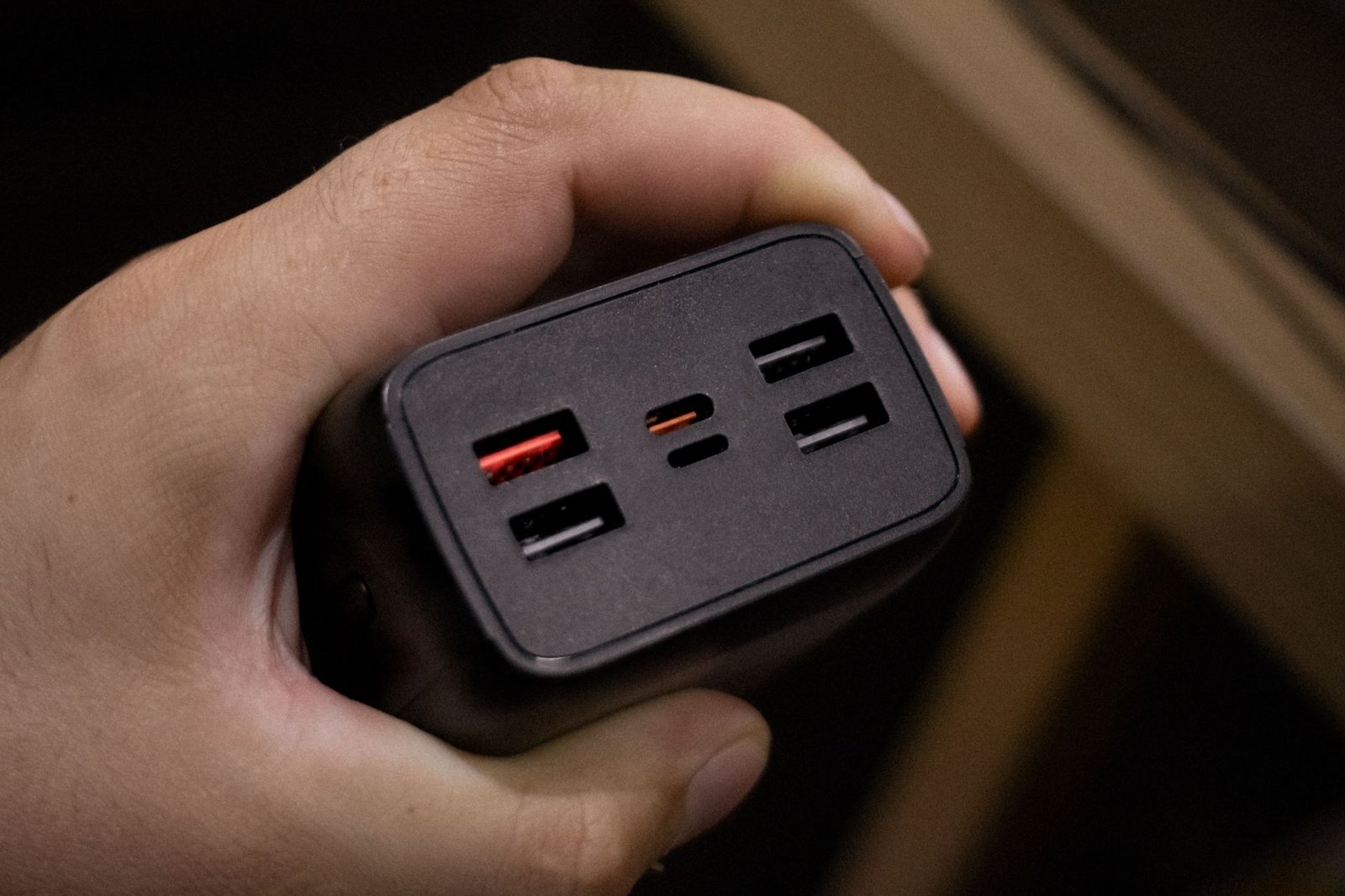
Here is the part the box does not want you to think about. The big number printed on a multi-port charger is the total it can deliver, not the amount any single port guarantees once another device is plugged in. The moment you share a charger, it splits power, and your laptop is usually the one that gives some back. Modern USB-C fast charging follows the USB Power Delivery standard, which lets the charger and each device negotiate power on the fly.
Total wattage is a ceiling, not a promise. Take the compact Anker 735 (Nano II 65W) as a clear example. Plug in one laptop alone and the top USB-C port delivers the full 65W. Add a phone to the second USB-C port and that top port drops to 45W while the phone gets 20W. Fill all three ports and the laptop port falls again to 40W, with 12W each left for the other two. Nothing is broken; that is just how power sharing works.
A simple framework before you buy
Do the math for your worst-case moment, not your best one. Ask three questions:
- What is my most demanding device? A 13-inch laptop wants 45W to 65W to charge while you use it. A 14 or 16-inch laptop can want 65W to 100W.
- What else will be plugged in at the same time? Every extra device eats into that number.
- Does the charger still feed my laptop enough with everything connected? If the answer is no, size up.
The practical rule: buy for the load you actually run at once, then add a little headroom. If you charge a 65W laptop and a phone together, a charger whose top port holds near 65W under sharing (or a 100W unit that splits to a comfortable 65W) keeps your laptop full. A 65W total charger will quietly become a roughly 45W laptop charger the second the phone joins in, which is fine for a thin ultrabook and slow for a hungry one. The same logic applies whether you are packing for a flight or wiring up a hotel desk once you land abroad already connected with a travel eSIM.
The best GaN charger 2026 picks, by use case
These picks cover the real use cases: one all-rounder, one value option, one that is refreshingly honest about power sharing, one true pocket cube, and one for people running two laptops. Every spec below comes from the manufacturer or a first-party listing.
Anker Prime 100W: the best all-round travel cube
Two USB-C ports and one USB-A live on a brick that measures about 1.7 by 1.1 by 2.7 inches and weighs roughly 6 ounces, with a foldable plug that sits flush in luggage. Either USB-C port can push the full 100W on its own. Share it and the total holds at 100W across two ports; fill all three and the two USB-C ports split 65W while USB-A takes 24W. That 65W floor for a laptop, even with a phone and a third device attached, is exactly the headroom the framework above asks for. Anker’s ActiveShield 2.0 also watches temperature constantly, which matters in a hot carry-on.
This is the cube most travelers should default to. It replaces a laptop brick and a phone plug outright, and the spare port covers a tablet or a friend. GaN pricing moves often, so it pays to check before you commit.
Check the Anker Prime 100W price on Amazon →
UGREEN Nexode 65W: best value for phone plus laptop
UGREEN’s Nexode 65W runs two USB-C ports and one USB-A, and either USB-C port can deliver the full 65W to a thin laptop on its own. The foldable plug and GaN internals make it roughly half the size of an old 65W brick. Power splits sensibly across the three ports when you charge a phone and tablet alongside, though as with any 65W total unit, the laptop share drops once you load the other ports.
For a phone plus an ultrabook, this is the value sweet spot and the one to grab if the Prime feels like more charger than you need.
Check the UGREEN Nexode 65W price on Amazon →
Anker 735 Nano II 65W: most honest about power sharing
The 735 earns its spot precisely because Anker publishes the exact split, and it is the cleanest teaching example of the wattage gotcha. One device gets 65W. Two USB-C devices get 45W and 20W. Three devices get 40W, 12W, and 12W. Nothing hidden. For a single laptop or a laptop-and-phone pair on a thin machine, it is compact, proven, and widely available. Just know the top port is a 45W port the moment a second device joins, so a power-hungry 16-inch laptop is not its ideal partner. You can check its current price on Amazon if the honest power split fits your kit.
Anker 511 Nano 3 30W: the true matchbox for phone-first packers
This is the one that actually fits the matchbox promise. A single USB-C port, 30W, a folding plug, and a body around 28 by 28 by 35 mm at roughly 47 grams. It is about 70 percent smaller than the original 30W brick. It will not run a big laptop at full tilt, but it fast-charges a phone, tops up a tablet, and even trickles a MacBook Air. If your trip is phone-first and your laptop stays home, this is the lightest honest answer.
Check the Anker 511 Nano 3 price on Amazon →
UGREEN Nexode 100W: for two laptops and a full desk
Three USB-C ports and one USB-A, with either primary USB-C port capable of the full 100W solo. This is the pick for the person running a work laptop, a personal laptop, a phone, and a tablet off one wall socket. It is larger than the pocket cubes, so it is a desk-and-hotel charger rather than a jeans-pocket one. Total output is 100W shared across four ports, which is plenty for one laptop and three smaller devices, and tight only if you truly try to fast-charge two big laptops at once. If that is your setup, check its current price on Amazon.
How the 2026 GaN charger picks compare
| Charger | Ports | Max single-port | With a laptop + phone sharing | Best for | Price |
|---|---|---|---|---|---|
| Anker Prime 100W | 2C + 1A | 100W | ~65W to laptop (2 more devices) | All-round travel | check price |
| UGREEN Nexode 65W | 2C + 1A | 65W | ~45W to laptop | Phone + thin laptop value | check price |
| Anker 735 Nano II 65W | 2C + 1A | 65W | 45W + 20W | Single laptop, compact | check price |
| Anker 511 Nano 3 30W | 1C | 30W | phone-only | Phone-first packing | check price |
| UGREEN Nexode 100W | 3C + 1A | 100W | 100W split 4 ways | Two laptops / desk | check price |
Each “check price” link opens the current Amazon listing, because GaN prices swing with sales more than almost any gadget category.
Which one belongs in your bag
Match the charger to the heaviest moment in your day, then stop overthinking it. If you carry a laptop and a phone and want one cube to rule the trip, the Anker Prime 100W is the answer, full stop. Watching your spend on a thin-laptop setup? The UGREEN Nexode 65W does the same core job for less. Traveling phone-first with the laptop left at home? The Anker 511 Nano 3 disappears into a pocket. And if two laptops share your desk, the UGREEN Nexode 100W feeds the whole cluster.
One cube, three bricks gone, a lighter bag. That is the entire pitch, and for once the gadget lives up to it. While you are trimming your travel kit, it is also worth a minute to decide whether you actually need a VPN on hotel and airport WiFi before your next trip, so your bag and your setup both travel light.